
Market Insight #5 — Stopped Out, Staying Disciplined
Hello everyone, and welcome to this week’s Market Insight.
Portfolio Update
Asset | Position | Order Type |
|---|---|---|
Bitcoin | Closed | Stop Market |
Solana | Closed | Stop Market |
Ethereum | Closed | Stop Market |
Ripple | Closed | Stop Market |
Good news and bad news. The bad news is that I was stopped out of all positions this week. The portfolio is now 100% in cash. The good news is that the stops worked exactly as intended. I’m down about 5%, while Bitcoin is down more than 10% since January 1st. That difference is the entire point of using stop losses. Risk management isn’t exciting when you open positions, but it’s how you survive over time. In this case, the plan did its job, and I now have dry powder for the next opportunity.
Based on the framework I laid out last week, we’re now in either scenario 2 or scenario 3. From what I’m seeing, I’m still leaning toward scenario 3.
If Bitcoin closes the week above $80k, or if any of my re‑entry signals flash, I’ll look to start rebuilding positions next week. That doesn’t mean going all‑in. It means stepping back in carefully, if the setup improves.
If neither happens, I’ll reassess the thesis and begin preparing for scenario 2, where Bitcoin continues lower, potentially toward the $50k area.
I’m comfortable with this outcome. I’d rather be stopped out and re‑enter later than hold and bleed for longer periods. Crypto returns are asymmetric. Missing the exact bottom doesn’t matter if the trend resumes, but holding through prolonged drawdowns does. It’s mentally demanding, and I’d rather be flat, clear‑headed, and ready for the right opportunity, which I still believe is around the corner.
Being in cash is a position too.
The macro backdrop remains broadly supportive.
This week, the ISM Manufacturing Index came in better than expected and moved above 50 for the first time in more than three years. A reading above 50 signals economic expansion: new orders are rising, production is increasing, companies are hiring, and consumers have more disposable income. ISM is one of the most reliable forward‑looking indicators of the business cycle. It often turns before broader growth data and helps frame whether the environment is shifting toward risk‑on or risk‑off.
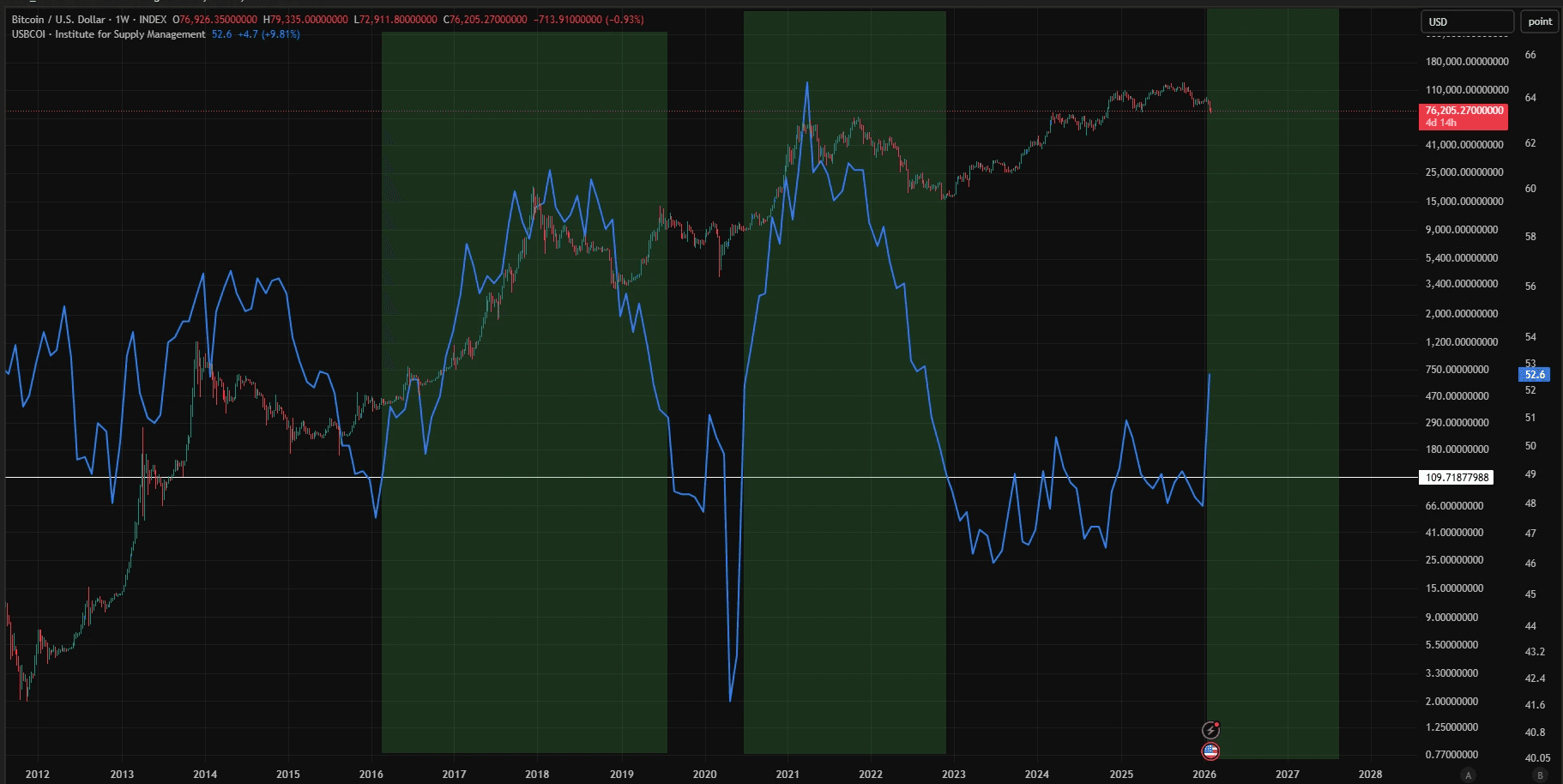
This matters because cyclical assets, including small caps and crypto, tend to perform best when economic momentum is improving. Expansion phases often create a positive feedback loop of higher activity, higher income, and higher spending.
Combined with disinflation and improving liquidity conditions, this keeps my broader outlook constructive. The key question isn’t whether to be involved , it’s when to re‑enter with better timing and lower risk of getting stopped out again.
Education of the week:
Coin Days Destroyed (CDD)
Last week we covered the Long-Term Holder Supply Net Position Change. This week I want to introduce you to Coin Days Destroyed. While supply net position change tells us how much supply is changing hands, CDD tells us how old the coins are that are moving.
Think of it this way:
1 BTC held for 1 day = 1 coin-day
10 BTC held for 100 days = 1,000 coin-days
If those 10 BTC move after 100 days, 1,000 coin-days are destroyed.
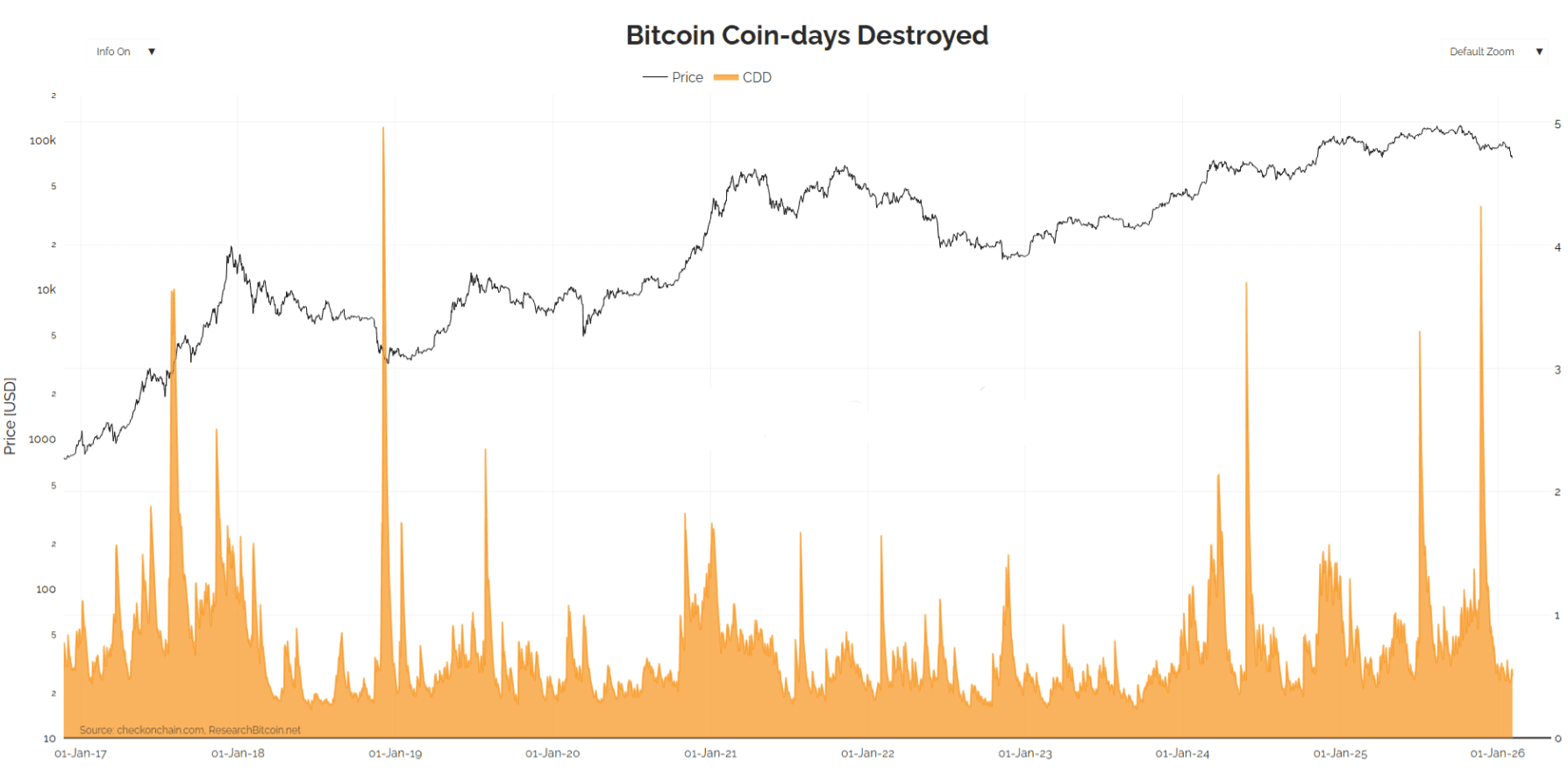
Large spikes in CDD usually mean that very old coins are moving, which typically reflects long-term holders taking action. Historically, these spikes tend to occur:
Near market tops, as long-term holders sell into strength
And near major bottoms, when remaining long-term holders become sellers of last resort after short-term holders have already exited
The current reading is the second-highest on record, previously only seen near the 2019 Bitcoin bottom. Taken with the Long-Term Holder Supply Net Position Change from last week, these indicators suggest that a large amount of long-term selling pressure has already occurred, and that remaining long-term holders are beginning to accumulate again.
In 2019, similar conditions marked a period where Bitcoin spent roughly three months stabilising, followed by a strong advance over the next several months. We are now roughly three months removed from the recent distribution peak. While history never repeats exactly, the on-chain data suggests that downside risk is diminishing and that the market is transitioning from distribution toward accumulation.
This doesn’t guarantee higher prices in the short term, but it does suggest that the balance of long-term supply is becoming more constructive.
That’s all for now. Same plan, same discipline.
Trilux
Explore more blogs
Fintech is its potential to promote financial inclusion. In many parts of the world, millions of people lack access to traditional banking services.